


Sam Jethroe was nicknamed the Jet because he could run so fast that one of his teammates declared that he could “outrun the word of God.” At Lincoln Senior High, he played football, basketball, baseball and even boxed. His favorite game though was baseball. After graduation, he played for the East Saint Louis Giants, then the East Saint Louis Colts, a semi-pro team from which many people were drafted into the Major Leagues.
As a Negro League player, he proved that he was unstoppable. One opponent noticed that Jethroe had a tell; when he was going to steal bases, he would pull up his pants leg. Even with this knowledge, the opponent could not stop him because he was just that fast. The baseball great even beat Olympic Gold Medalist sprinter, Barney Ewell, in a foot race. But to be a great baseball player you needed more than speed. In 1944 and 1945, the switch-hitter led the league in both batting, and stolen bases with batting averages at .353 and .393 and stolen bases with 18 and 21 respectively. While in the league, Jethroe led his team, The Cleveland Buckeyes, to the Negro American League pennant with a 4-0 sweep of the Homestead Grays.
Years before Jackie Robinson would become the first African American in the major leagues, Jethroe, Robinson, and Marvin Williams, all tried out for the Boston Red Sox, but neither were chosen for the team, despite their prowess as players.
In 1950, Jethroe was the first African-American signed to the Boston Braves, and only the sixth African American in the league. That year, he puts his jets on once again and led the league in stolen bases (35) and a batting average of .273. He claimed Rookie of the Year Honors, and to this day, still remains the record holder for the oldest Rookie of the Year in the League.
Sam “The Jet” Jethroe, your Legendary Local. See Legendary East Saint Louisans by Reginald Petty and Tiffany Lee at http://amzn.to/29Bs21o.


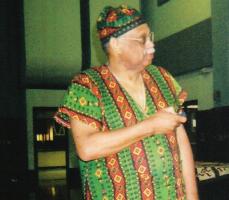

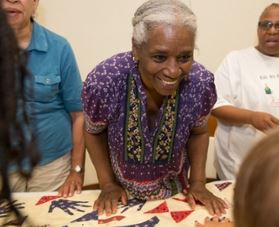
 Her quilts tell a story that weaves through the fabric of experiences of all mankind. Her artistry speaks of our history, our triumphs and our weaknesses. For this reason, Edna Pattinson-Petty’s work is extolled not only in her hometown or even America, but by people in foreign lands, such as Beijing, China; Senegal, Africa; Ottawa, Canada; and Islamabad, Pakistan, who identify with her work which exemplifies ‘the human condition.’ Whether it is her latest quilt, created to educate on the deadly 1917 Riots of E. St. Louis, which symbolizes the cruelties of mankind; or her quilt, “If it Wasn’t for the Women,” which was constructed to represent the strength of all women, there is a visceral connection to her art that supersedes religious, ethnic and racial boundaries. Her works speak a universal language that isn’t muddied by words. She says of her gift, “I know that my creative ability is of divine inspiration, because I dream art, I feel art, I get excited when I am around art, and through my creations I reveal my internal world.”
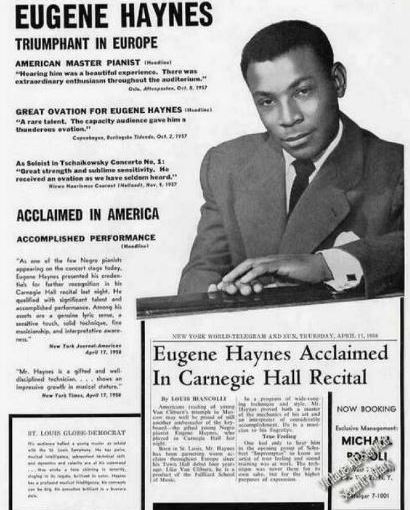
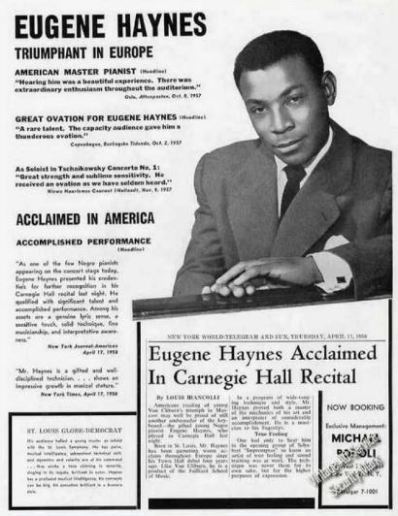 was born in East Saint Louis at his parent’s home on Missouri Ave. Mr. Haynes was a self-taught musical prodigy whose talents became clear at the young age of four. Upon graduating from Lincoln Senior high, he attended Julliard School of Music. Here he would welcome his hometown friend Miles Davis. As a classical pianist, Haynes made his debut at Carnegie Hall in 1958. His performance would prove so electrifying that he would be asked to perform later that same year at the World’s Fair in Brussels, Belgium.
 TiffanyRose Publishing